Ontario's New Attendance and Exam Rules: What Parents Need to Know
Ontario's New Attendance and Exam Rules: What Parents Need to Know
Ontario's New Attendance and Exam Rules: What Parents Need to Know

5 mins reading time
5 mins reading time

Quick Summary
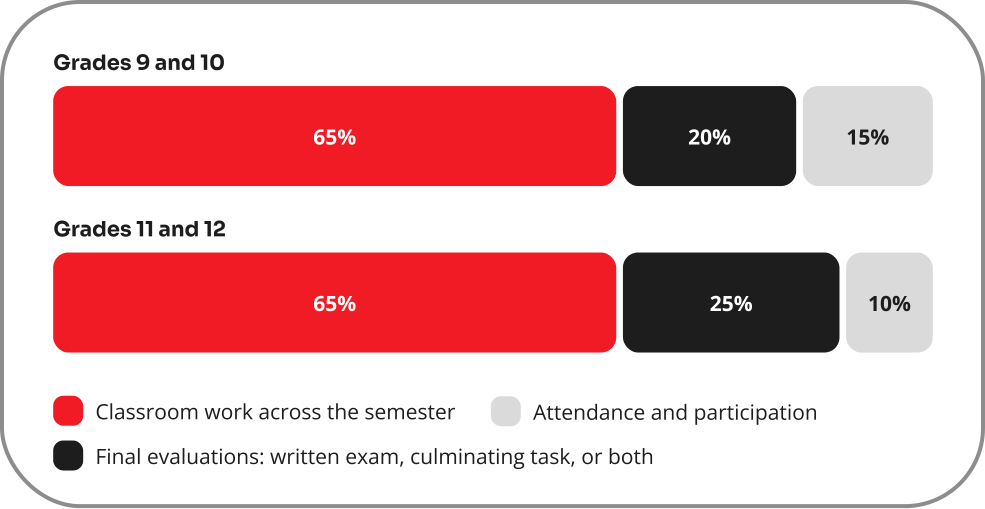
Ontario's assessment rules changed for 2026-27. Final marks in Grades 9 and 10 are now 65% classroom work, 20% final evaluations and 15% attendance and participation. In Grades 11 and 12 it's 65/25/10. Written exams are mandatory again in most courses. Only unexcused absences count against the mark, and the top band means missing no more than about two classes a semester.
Quick Summary
Ontario's assessment rules changed for 2026-27. Final marks in Grades 9 and 10 are now 65% classroom work, 20% final evaluations and 15% attendance and participation. In Grades 11 and 12 it's 65/25/10. Written exams are mandatory again in most courses. Only unexcused absences count against the mark, and the top band means missing no more than about two classes a semester.
Quick Summary
Ontario's assessment rules changed for 2026-27. Final marks in Grades 9 and 10 are now 65% classroom work, 20% final evaluations and 15% attendance and participation. In Grades 11 and 12 it's 65/25/10. Written exams are mandatory again in most courses. Only unexcused absences count against the mark, and the top band means missing no more than about two classes a semester.
Ontario's new assessment and evaluation requirements took effect with the 2026-27 school year, and unlike most policy changes, this one applies from the first day of the semester rather than phasing in later. The rules replace Chapter 5 of Growing Success, the province's long-standing assessment policy, and they change two things at once: attendance and participation now carry a defined share of every final mark, and written final exams are mandatory in most courses again.
Here is what that actually means for a mark, and what is worth sorting out in the first weeks of term.
The new mark breakdown
Every course in Grades 9 to 12 now uses one of two fixed formulas.
Grades 9 and 10
65% classroom work completed throughout the course
20% final evaluations
15% attendance and participation
Grades 11 and 12
65% classroom work completed throughout the course
25% final evaluations
10% attendance and participation
The 65% is familiar territory: the tests, assignments, labs and essays that happen across the semester. What is new is that the remaining 35% is now defined by the province rather than by individual teachers or schools, and that a slice of it is not about academic performance at all.
The part most families miss: it is not only about showing up
The attendance and participation mark is assessed on a five-level scale, and the top band is tighter than most parents expect.
To reach Level 4, which is worth 80% to 100% of that component, a student must miss no more than roughly 2.5% of classes to unexcused absences. In a single semester, that works out to about two classes. Level 3 covers roughly 2.5 to 4.5 missed classes, Level 2 covers about five to seven, and Level 1 covers about 7.5 to nine. Beyond nine unexcused absences in a semester, a student falls below Level 1 and receives less than 50% of the component.
For a Grade 9 student, that bottom band means losing at least 7.5 marks off the final grade in that course. That is roughly the distance between an 80 and a 72, and it cannot be recovered by doing better on an assignment in November.
The second half of the criteria is the part that gets less attention. Alongside the attendance thresholds, each level describes participation: contributing ideas to class discussion, asking relevant questions, respecting others' contributions, and helping build a positive classroom culture. Level 4 requires a student to do these things consistently. Level 2 describes a student who does them occasionally.
In our experience, that pairing catches families off guard, because the students most affected are not usually the ones skipping class. They are the quiet, conscientious teens with near-perfect attendance who rarely speak up. The ministry criteria do not spell out how a teacher should weigh strong attendance against limited participation, and schools are working through that in practice this fall. If your teen is naturally reserved, this is worth a conversation with the classroom teacher early, not in January.
Excused absences do not count against the mark
This is the reassurance worth passing along to anxious teens: excused absences do not lower the mark. Only unexcused ones do.
The province defines excused absences by pointing to Ontario's enrolment register instructions, and they include illness and other unavoidable circumstances such as severe weather, along with approved absences like cultural days and holy days. Families can also request leave for things like a sports tournament or a music competition, though the school decides whether it qualifies. Education Minister Paul Calandra clarified in June that parents can still request that kind of leave, while signalling it should not become routine.
The practical point is administrative rather than philosophical. The distinction between excused and unexcused is recorded by the school, often on the day of the absence. If your teen is home with strep throat and nobody reports it in the way your school expects, that absence may sit in the wrong column. Find out now how your school wants absences reported and whether any documentation is needed.
Written exams are back, and the weight varies by subject
All written final exams in Grades 9 to 12 now take place during a designated exam period, which means the exam-free semester many students have grown used to is over.

In English, mathematics and science, the written exam carries the full final evaluation weight: 20% in Grades 9 and 10, and 25% in Grades 11 and 12. In Canadian and world studies, Grades 9 and 10 write a 20% exam, while Grades 11 and 12 have a 15% exam plus a 10% culminating task. Most other subjects, including the arts, business studies, computer studies, health and physical education, technological education, languages and social sciences, split the weight between a smaller written exam and a culminating task.
Some courses are exempt: locally developed compulsory credit courses in Grades 9 and 10, workplace preparation (E) and open (O) courses in Grades 11 and 12, co-operative education, interdisciplinary studies, American Sign Language as a Second Language, and Guidance and Career Education apart from Grade 10 Career Studies. These still require a final evaluation of the same weight, just not necessarily a written exam.
Two grade-specific notes:
Grade 9 math. The EQAO Grade 9 Assessment of Mathematics now counts as the written exam for MTH1W and is worth 20% of the final mark. It is the one exam written outside the designated exam period.
Grade 10 Career Studies. The final 20% is made up of the new financial literacy graduation requirement, worth 5%, and a 15% culminating task. Students need 70% or higher on the TVO-developed modules to meet the requirement, and they get two attempts during the course, with the higher mark counting.
For many students in Grade 9 and 10, January will be their first formal written exam. Writing one is a skill in its own right, separate from knowing the material, and it is worth building study habits that hold up under exam conditions in the fall rather than discovering the gap in January.
What to do in the first weeks
Ask each teacher how the final evaluation is structured in that specific course. Exam-only and exam-plus-project courses call for different planning.
Confirm how your school records absences and what it needs from you to mark one excused.
If your teen is quiet in class, raise it with teachers now rather than after the first report card.
Watch for early avoidance. A teen who starts missing one class repeatedly is usually telling you something, and under these rules the cost accumulates faster than it used to. It is worth ruling out academic burnout before assuming the problem is motivation.
Keep September steady. The 65% still carries most of the mark, and momentum in the first six weeks matters more than any single change to the formula. Most of what protects it is ordinary back-to-school set-up: a workable routine, a quiet place to study, and a calendar the whole house can see.
None of this changes what good support looks like. It does mean that ordinary, unremarkable consistency, showing up and speaking up, now shows up on the report card. If your teen is finding that harder than it should be, that is worth looking at early in the semester rather than after the marks are set.
A lot changed over the summer, and it's fair to still be working out what it means for your own household. If you'd like help sorting out how the new rules affect your teen's courses this semester, we're always happy to talk it through. Get in touch whenever you're ready.
Ontario's new assessment and evaluation requirements took effect with the 2026-27 school year, and unlike most policy changes, this one applies from the first day of the semester rather than phasing in later. The rules replace Chapter 5 of Growing Success, the province's long-standing assessment policy, and they change two things at once: attendance and participation now carry a defined share of every final mark, and written final exams are mandatory in most courses again.
Here is what that actually means for a mark, and what is worth sorting out in the first weeks of term.
The new mark breakdown
Every course in Grades 9 to 12 now uses one of two fixed formulas.
Grades 9 and 10
65% classroom work completed throughout the course
20% final evaluations
15% attendance and participation
Grades 11 and 12
65% classroom work completed throughout the course
25% final evaluations
10% attendance and participation
The 65% is familiar territory: the tests, assignments, labs and essays that happen across the semester. What is new is that the remaining 35% is now defined by the province rather than by individual teachers or schools, and that a slice of it is not about academic performance at all.
The part most families miss: it is not only about showing up
The attendance and participation mark is assessed on a five-level scale, and the top band is tighter than most parents expect.
To reach Level 4, which is worth 80% to 100% of that component, a student must miss no more than roughly 2.5% of classes to unexcused absences. In a single semester, that works out to about two classes. Level 3 covers roughly 2.5 to 4.5 missed classes, Level 2 covers about five to seven, and Level 1 covers about 7.5 to nine. Beyond nine unexcused absences in a semester, a student falls below Level 1 and receives less than 50% of the component.
For a Grade 9 student, that bottom band means losing at least 7.5 marks off the final grade in that course. That is roughly the distance between an 80 and a 72, and it cannot be recovered by doing better on an assignment in November.
The second half of the criteria is the part that gets less attention. Alongside the attendance thresholds, each level describes participation: contributing ideas to class discussion, asking relevant questions, respecting others' contributions, and helping build a positive classroom culture. Level 4 requires a student to do these things consistently. Level 2 describes a student who does them occasionally.
In our experience, that pairing catches families off guard, because the students most affected are not usually the ones skipping class. They are the quiet, conscientious teens with near-perfect attendance who rarely speak up. The ministry criteria do not spell out how a teacher should weigh strong attendance against limited participation, and schools are working through that in practice this fall. If your teen is naturally reserved, this is worth a conversation with the classroom teacher early, not in January.
Excused absences do not count against the mark
This is the reassurance worth passing along to anxious teens: excused absences do not lower the mark. Only unexcused ones do.
The province defines excused absences by pointing to Ontario's enrolment register instructions, and they include illness and other unavoidable circumstances such as severe weather, along with approved absences like cultural days and holy days. Families can also request leave for things like a sports tournament or a music competition, though the school decides whether it qualifies. Education Minister Paul Calandra clarified in June that parents can still request that kind of leave, while signalling it should not become routine.
The practical point is administrative rather than philosophical. The distinction between excused and unexcused is recorded by the school, often on the day of the absence. If your teen is home with strep throat and nobody reports it in the way your school expects, that absence may sit in the wrong column. Find out now how your school wants absences reported and whether any documentation is needed.
Written exams are back, and the weight varies by subject
All written final exams in Grades 9 to 12 now take place during a designated exam period, which means the exam-free semester many students have grown used to is over.
In English, mathematics and science, the written exam carries the full final evaluation weight: 20% in Grades 9 and 10, and 25% in Grades 11 and 12. In Canadian and world studies, Grades 9 and 10 write a 20% exam, while Grades 11 and 12 have a 15% exam plus a 10% culminating task. Most other subjects, including the arts, business studies, computer studies, health and physical education, technological education, languages and social sciences, split the weight between a smaller written exam and a culminating task.
Some courses are exempt: locally developed compulsory credit courses in Grades 9 and 10, workplace preparation (E) and open (O) courses in Grades 11 and 12, co-operative education, interdisciplinary studies, American Sign Language as a Second Language, and Guidance and Career Education apart from Grade 10 Career Studies. These still require a final evaluation of the same weight, just not necessarily a written exam.
Two grade-specific notes:
Grade 9 math. The EQAO Grade 9 Assessment of Mathematics now counts as the written exam for MTH1W and is worth 20% of the final mark. It is the one exam written outside the designated exam period.
Grade 10 Career Studies. The final 20% is made up of the new financial literacy graduation requirement, worth 5%, and a 15% culminating task. Students need 70% or higher on the TVO-developed modules to meet the requirement, and they get two attempts during the course, with the higher mark counting.
For many students in Grade 9 and 10, January will be their first formal written exam. Writing one is a skill in its own right, separate from knowing the material, and it is worth building study habits that hold up under exam conditions in the fall rather than discovering the gap in January.
What to do in the first weeks
Ask each teacher how the final evaluation is structured in that specific course. Exam-only and exam-plus-project courses call for different planning.
Confirm how your school records absences and what it needs from you to mark one excused.
If your teen is quiet in class, raise it with teachers now rather than after the first report card.
Watch for early avoidance. A teen who starts missing one class repeatedly is usually telling you something, and under these rules the cost accumulates faster than it used to. It is worth ruling out academic burnout before assuming the problem is motivation.
Keep September steady. The 65% still carries most of the mark, and momentum in the first six weeks matters more than any single change to the formula. Most of what protects it is ordinary back-to-school set-up: a workable routine, a quiet place to study, and a calendar the whole house can see.
None of this changes what good support looks like. It does mean that ordinary, unremarkable consistency, showing up and speaking up, now shows up on the report card. If your teen is finding that harder than it should be, that is worth looking at early in the semester rather than after the marks are set.
A lot changed over the summer, and it's fair to still be working out what it means for your own household. If you'd like help sorting out how the new rules affect your teen's courses this semester, we're always happy to talk it through. Get in touch whenever you're ready.
For more expert insights and personalized learning support, explore GOAL Tutoring’s services or read other articles on our website.
For more expert insights and personalized learning support, explore GOAL Tutoring’s services or read other articles on our website.
Not Sure Yet?
Start with a Free Session
Try a full hour of personalized 1-on-1 online tutoring at no cost
No credit card, no commitment, just a chance to see how we work
A $50 value, completely free
Book a Free Session

Not Sure Yet?
Start with a Free Session
Try a full hour of personalized 1-on-1 online tutoring at no cost
No credit card, no commitment, just a chance to see how we work
A $50 value, completely free
Book a Free Session
Not Sure Yet?
Start with a Free Session
Try a full hour of personalized 1-on-1 online tutoring at no cost
No credit card, no commitment, just a chance to see how we work
A $50 value, completely free
Book a Free Session
Not Sure Yet?
Start with a Free Session
Try a full hour of personalized 1-on-1 online tutoring at no cost
No credit card, no commitment, just a chance to see how we work
A $50 value, completely free
Book a Free Session



Get in Touch
+1 (647) 924-5352
info@goal-tutoring.com
5793 Yonge St
North York ON M2M 0A9 Canada
Copyright © 2025 Goal Tutoring. All Rights Reserved.
Get in Touch
+1 (647) 924-5352
info@goal-tutoring.com
5793 Yonge St
North York ON M2M 0A9 Canada
Copyright © 2025 Goal Tutoring. All Rights Reserved.
Get in Touch
Copyright © 2025 Goal Tutoring. All Rights Reserved.
Get in Touch
+1 (647) 924-5352
info@goal-tutoring.com
5793 Yonge St, North York, ON M2M 0A9
Copyright © 2025 Goal Tutoring. All Rights Reserved.