Teen Exam Stress in Ontario: How Parents Can Help
Teen Exam Stress in Ontario: How Parents Can Help
Teen Exam Stress in Ontario: How Parents Can Help

8 mins reading time
8 mins reading time

Quick Summary
Exam stress is normal for Ontario high school students, but it's worth knowing when to step in. Watch for sustained signs like poor sleep, irritability, and withdrawal. Help your teen build a realistic study schedule, keep home life calm and predictable, and ask how they're feeling rather than how much they've studied. After exams, focus on their effort rather than their results. If stress tips into persistent anxiety or hopelessness, reach out to a school counsellor or GP.
Quick Summary
Exam stress is normal for Ontario high school students, but it's worth knowing when to step in. Watch for sustained signs like poor sleep, irritability, and withdrawal. Help your teen build a realistic study schedule, keep home life calm and predictable, and ask how they're feeling rather than how much they've studied. After exams, focus on their effort rather than their results. If stress tips into persistent anxiety or hopelessness, reach out to a school counsellor or GP.
Quick Summary
Exam stress is normal for Ontario high school students, but it's worth knowing when to step in. Watch for sustained signs like poor sleep, irritability, and withdrawal. Help your teen build a realistic study schedule, keep home life calm and predictable, and ask how they're feeling rather than how much they've studied. After exams, focus on their effort rather than their results. If stress tips into persistent anxiety or hopelessness, reach out to a school counsellor or GP.
As culminating tasks, exam prep and major assignments pile up as exam season draws closer, you feel it at home too, even when you’re not the one taking them. You notice it in the way they’ve stopped eating properly. You notice it when a small question at dinner turns into an argument at seven o’clock. And you notice it at 11pm, with the light still on under their door.
Exam stress is one of the most common things Ontario parents bring to us during the second half of the school year. And it makes sense: high school grades here carry real weight. University applications, scholarship eligibility, credit completion. When exam time arrives, your teen knows what’s riding on it.
According to the Ontario Student Trustees’ Association, around 70% of students report high levels of academic stress during exams, with finals the single biggest driver. That number probably feels low to most parents.
There is quite a lot you can do to help your teen through it without taking over their revision or turning up the pressure. This guide covers the signs worth watching for, what works before and during exams, how to handle the aftermath, and when examination stress warrants more support than a parent can offer alone.
What Are the Signs of Exam Stress in Teenagers?
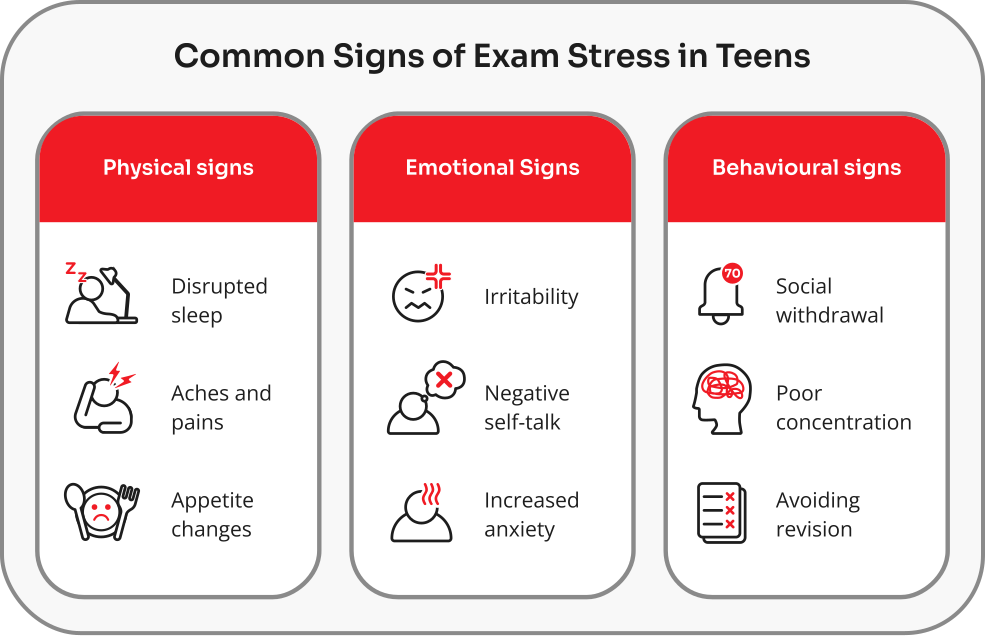
Exam stress and exam anxiety can look a lot like ordinary teenage behaviour, which is part of what makes them easy to miss or misread as general moodiness. A change in attitude for a day or two before a big test is completely normal. The pattern worth paying attention to is when it is sustained, and showing up across several areas at once.
Physical signs:
Disrupted sleep: trouble falling asleep, waking in the night, or barely being able to get up in the morning
Headaches and stomach aches with no clear cause
Loss of appetite, or the reverse: stress-eating and skipping balanced meals
Looking visibly tense or physically restless for long stretches
Emotional and behavioural signs:
Irritability that seems out of proportion to whatever triggered it
Withdrawing from family, friends, and the activities they normally look forward to
Difficulty concentrating even during study sessions
Negative self-talk: “I’m going to fail” or “there’s no point trying”
Avoiding revision altogether, even when they’re clearly stressed about exams
If several of these are showing up together and persisting over weeks rather than days, that is worth taking seriously. There is more on that further down.
As Exams Approach: Setting a Strong Foundation
Ask Before You Advise
Ontario’s high school system mixes final exams, culminating tasks, and standardised assessments. For students in Grades 11 and 12, the schedule runs from late May through June, and AP and IB students face stressful exams even earlier in May. The point is that every student’s exam season has its own particular shape, and it helps to understand your teen’s version of it before you weigh in.
Which subjects feel shakiest? Which exams fall back-to-back? Which ones carry the most weight for their post-secondary plans? Start there. You don’t need all the answers. You just need to show you’re paying genuine attention.
Help Them Build a Study Plan Without Building It for Them
One of the most effective ways to ease examination stress is to replace vague dread with a specific written plan. The key is working backwards from each exam date. “I’ll study this weekend” is not a plan. It is a setup for a Sunday night panic when the weekend disappears and nothing has been done.
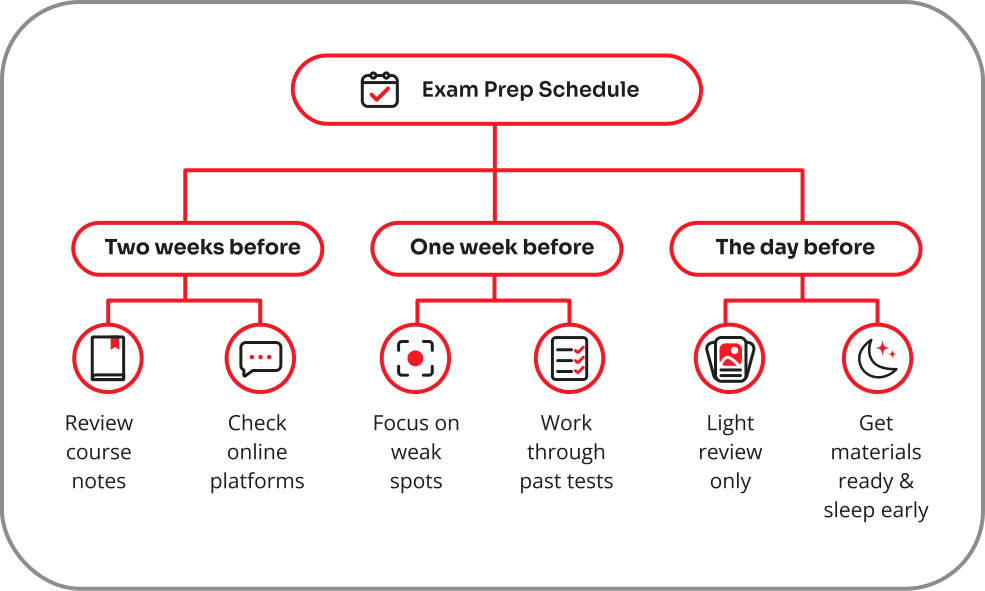
A schedule with specific tasks mapped to specific days turns something overwhelming into something manageable:
Two weeks before: Review course notes, identify weak areas, and check Google Classroom or D2L Brightspace for teacher-posted review materials.
One week before: Focus on problem areas, work through old quizzes and unit tests, and address anything that still feels uncertain.
The day before: Light review only. Get all materials ready, and get to bed at a reasonable hour.
The Study Space Matters More Than Most Parents Expect
A consistent, quiet study space makes a measurable difference. Research shows that studying in the same location improves memory retention, so even a cleared kitchen table with the phone in another room is more effective than a bedroom desk buried under notifications.
Limiting phone access during study sessions is one of the most effective changes a stressed student can make, and one of the most resisted. Apps like Forest, or the built-in Focus mode on most phones, can help your teen manage their own time without you having to be the enforcer.
During Exam Season: Support That Does Not Add to the Pressure
Know the Difference Between Pressure That Helps and Pressure That Does Not
Some tension during exam time is completely normal, and it can keep students focused. The concern is when exam anxiety tips into something that shuts your teen down entirely: persistent insomnia, barely eating, expressing hopelessness, or withdrawing completely from the people and activities they normally care about. If several of those are showing up together and staying for weeks, it is worth reaching out to their school’s guidance counsellor. Many Ontario schools offer drop-in or virtual appointments during exam periods specifically.
What You Say Lands Differently Right Now
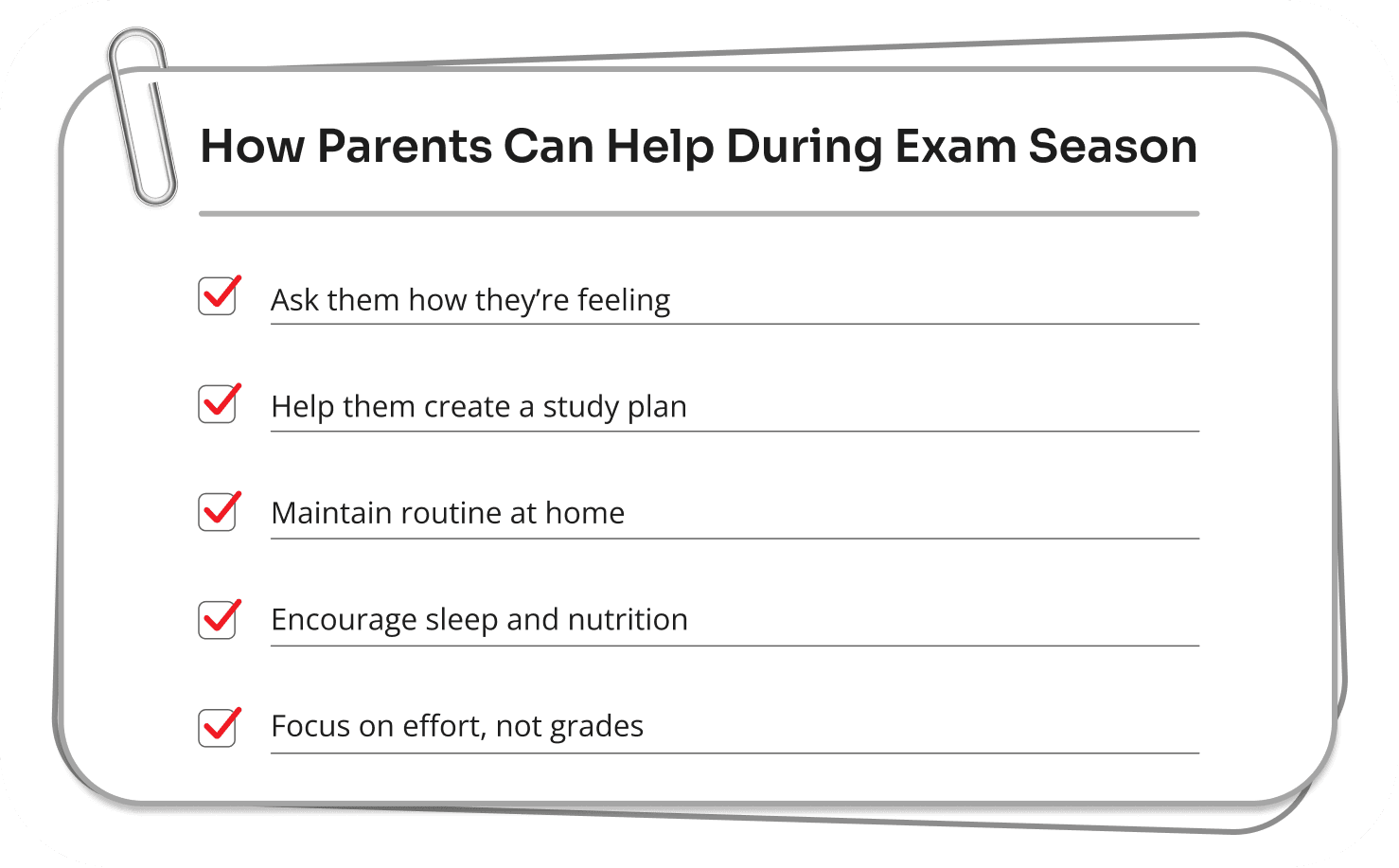
“Did you study enough?” is probably the question most likely to make things worse. Your teen already knows the stakes. What they need from you is steadiness, not another performance review.
“How are you feeling about tomorrow?” or “What can I do to help?” lands in a completely different place. Research consistently shows that teens whose parents focus on effort rather than outcomes report lower levels of exam anxiety. Being calm and available in the background turns out to be more useful than most parents expect.
Keep Home Life Predictable
Teens regulate stress partly through routine. Keeping meals, household rhythms, and sleeping hours consistent sends a quiet signal that everything is under control. Exam season is not the time to introduce extra responsibilities, family tensions, or disruptions to the schedule. Give them space where you can.
Sleep and Food Are Not Optional
A fatigued brain cannot consolidate new information. Staying up until midnight studying is almost always counterproductive: one extra hour of cramming rarely compensates for what poor sleep costs in focus and recall the next morning. The brain consolidates memory during sleep, so an early bedtime is genuinely better exam preparation than a late study session.
Keep the kitchen stocked with easy, nutritious food: granola, fruit, nut butter, yoghurt. And gently discourage the late-night energy drink habit that tends to appear around this time of year.
After Exams: How to Debrief Without Making It Worse
Once an exam is over, resist the urge to debrief the moment they walk through the door. Give them time to decompress. When you do check in, “How are you feeling?” is a far better opener than “How do you think you did?”
If results come back lower than expected, approach it together. Ontario’s education system offers real flexibility through credit recovery and summer school, so one stressful exam season is not the end of the story. What matters more in the long run is that your teen noticed their own effort: the perseverance, the improved organisation, the fact that they pushed through when they wanted to stop. Acknowledging those things out loud builds the kind of confidence that carries forward.
The weeks after exams are also one of the best times to address gaps and build study skills, precisely because there is no immediate pressure. Targeted, one-on-one tutoring during this period means students can focus on genuine understanding rather than anxious, last-minute revision.
When Exam Stress Becomes Something More
For most students, examination stress is temporary and manageable with the right support at home. For some, it develops into something that warrants professional attention. If your teen is experiencing persistent sleep disruption, significant changes in appetite, panic attacks, or expressing feelings of hopelessness over a sustained period, it is worth speaking to your family doctor or reaching out through your teen’s school.
School Mental Health Ontario and the Centre for Addiction and Mental Health both provide resources for Ontario students and families navigating academic stress and anxiety. Ontario school boards also have student support services available through guidance departments, and many are accessible during exam periods specifically.
FAQs
What are the most common signs of exam stress in teenagers?
How can I help my teenager cope with exam anxiety without adding pressure?
Is exam stress normal for Ontario high school students?
What should my teen do the night before an exam?
Should I get my teen a tutor during exam season?
What’s the difference between exam stress and test anxiety?
Supporting Your Teen Beyond Exam Season
Helping your teen navigate exam stress is not about making the pressure disappear. It is about being present, offering structure, and making sure they know that one difficult season does not define their potential.
Goal Tutoring’s Ontario-based tutors have worked with hundreds of high school students across subjects including maths, science, English, and French. Curriculum-aligned and working one-on-one, our tutors help students improve their grades while building the study habits and confidence that carry forward into every exam season that follows.
Get in touch with Goal Tutoring today to find out how we can support your teen.
As culminating tasks, exam prep and major assignments pile up as exam season draws closer, you feel it at home too, even when you’re not the one taking them. You notice it in the way they’ve stopped eating properly. You notice it when a small question at dinner turns into an argument at seven o’clock. And you notice it at 11pm, with the light still on under their door.
Exam stress is one of the most common things Ontario parents bring to us during the second half of the school year. And it makes sense: high school grades here carry real weight. University applications, scholarship eligibility, credit completion. When exam time arrives, your teen knows what’s riding on it.
According to the Ontario Student Trustees’ Association, around 70% of students report high levels of academic stress during exams, with finals the single biggest driver. That number probably feels low to most parents.
There is quite a lot you can do to help your teen through it without taking over their revision or turning up the pressure. This guide covers the signs worth watching for, what works before and during exams, how to handle the aftermath, and when examination stress warrants more support than a parent can offer alone.
What Are the Signs of Exam Stress in Teenagers?
Exam stress and exam anxiety can look a lot like ordinary teenage behaviour, which is part of what makes them easy to miss or misread as general moodiness. A change in attitude for a day or two before a big test is completely normal. The pattern worth paying attention to is when it is sustained, and showing up across several areas at once.
Physical signs:
Disrupted sleep: trouble falling asleep, waking in the night, or barely being able to get up in the morning
Headaches and stomach aches with no clear cause
Loss of appetite, or the reverse: stress-eating and skipping balanced meals
Looking visibly tense or physically restless for long stretches
Emotional and behavioural signs:
Irritability that seems out of proportion to whatever triggered it
Withdrawing from family, friends, and the activities they normally look forward to
Difficulty concentrating even during study sessions
Negative self-talk: “I’m going to fail” or “there’s no point trying”
Avoiding revision altogether, even when they’re clearly stressed about exams
If several of these are showing up together and persisting over weeks rather than days, that is worth taking seriously. There is more on that further down.
As Exams Approach: Setting a Strong Foundation
Ask Before You Advise
Ontario’s high school system mixes final exams, culminating tasks, and standardised assessments. For students in Grades 11 and 12, the schedule runs from late May through June, and AP and IB students face stressful exams even earlier in May. The point is that every student’s exam season has its own particular shape, and it helps to understand your teen’s version of it before you weigh in.
Which subjects feel shakiest? Which exams fall back-to-back? Which ones carry the most weight for their post-secondary plans? Start there. You don’t need all the answers. You just need to show you’re paying genuine attention.
Help Them Build a Study Plan Without Building It for Them
One of the most effective ways to ease examination stress is to replace vague dread with a specific written plan. The key is working backwards from each exam date. “I’ll study this weekend” is not a plan. It is a setup for a Sunday night panic when the weekend disappears and nothing has been done.
A schedule with specific tasks mapped to specific days turns something overwhelming into something manageable:
Two weeks before: Review course notes, identify weak areas, and check Google Classroom or D2L Brightspace for teacher-posted review materials.
One week before: Focus on problem areas, work through old quizzes and unit tests, and address anything that still feels uncertain.
The day before: Light review only. Get all materials ready, and get to bed at a reasonable hour.
The Study Space Matters More Than Most Parents Expect
A consistent, quiet study space makes a measurable difference. Research shows that studying in the same location improves memory retention, so even a cleared kitchen table with the phone in another room is more effective than a bedroom desk buried under notifications.
Limiting phone access during study sessions is one of the most effective changes a stressed student can make, and one of the most resisted. Apps like Forest, or the built-in Focus mode on most phones, can help your teen manage their own time without you having to be the enforcer.
During Exam Season: Support That Does Not Add to the Pressure
Know the Difference Between Pressure That Helps and Pressure That Does Not
Some tension during exam time is completely normal, and it can keep students focused. The concern is when exam anxiety tips into something that shuts your teen down entirely: persistent insomnia, barely eating, expressing hopelessness, or withdrawing completely from the people and activities they normally care about. If several of those are showing up together and staying for weeks, it is worth reaching out to their school’s guidance counsellor. Many Ontario schools offer drop-in or virtual appointments during exam periods specifically.
What You Say Lands Differently Right Now
“Did you study enough?” is probably the question most likely to make things worse. Your teen already knows the stakes. What they need from you is steadiness, not another performance review.
“How are you feeling about tomorrow?” or “What can I do to help?” lands in a completely different place. Research consistently shows that teens whose parents focus on effort rather than outcomes report lower levels of exam anxiety. Being calm and available in the background turns out to be more useful than most parents expect.
Keep Home Life Predictable
Teens regulate stress partly through routine. Keeping meals, household rhythms, and sleeping hours consistent sends a quiet signal that everything is under control. Exam season is not the time to introduce extra responsibilities, family tensions, or disruptions to the schedule. Give them space where you can.
Sleep and Food Are Not Optional
A fatigued brain cannot consolidate new information. Staying up until midnight studying is almost always counterproductive: one extra hour of cramming rarely compensates for what poor sleep costs in focus and recall the next morning. The brain consolidates memory during sleep, so an early bedtime is genuinely better exam preparation than a late study session.
Keep the kitchen stocked with easy, nutritious food: granola, fruit, nut butter, yoghurt. And gently discourage the late-night energy drink habit that tends to appear around this time of year.
After Exams: How to Debrief Without Making It Worse
Once an exam is over, resist the urge to debrief the moment they walk through the door. Give them time to decompress. When you do check in, “How are you feeling?” is a far better opener than “How do you think you did?”
If results come back lower than expected, approach it together. Ontario’s education system offers real flexibility through credit recovery and summer school, so one stressful exam season is not the end of the story. What matters more in the long run is that your teen noticed their own effort: the perseverance, the improved organisation, the fact that they pushed through when they wanted to stop. Acknowledging those things out loud builds the kind of confidence that carries forward.
The weeks after exams are also one of the best times to address gaps and build study skills, precisely because there is no immediate pressure. Targeted, one-on-one tutoring during this period means students can focus on genuine understanding rather than anxious, last-minute revision.
When Exam Stress Becomes Something More
For most students, examination stress is temporary and manageable with the right support at home. For some, it develops into something that warrants professional attention. If your teen is experiencing persistent sleep disruption, significant changes in appetite, panic attacks, or expressing feelings of hopelessness over a sustained period, it is worth speaking to your family doctor or reaching out through your teen’s school.
School Mental Health Ontario and the Centre for Addiction and Mental Health both provide resources for Ontario students and families navigating academic stress and anxiety. Ontario school boards also have student support services available through guidance departments, and many are accessible during exam periods specifically.
FAQs
What are the most common signs of exam stress in teenagers?
How can I help my teenager cope with exam anxiety without adding pressure?
Is exam stress normal for Ontario high school students?
What should my teen do the night before an exam?
Should I get my teen a tutor during exam season?
What’s the difference between exam stress and test anxiety?
Supporting Your Teen Beyond Exam Season
Helping your teen navigate exam stress is not about making the pressure disappear. It is about being present, offering structure, and making sure they know that one difficult season does not define their potential.
Goal Tutoring’s Ontario-based tutors have worked with hundreds of high school students across subjects including maths, science, English, and French. Curriculum-aligned and working one-on-one, our tutors help students improve their grades while building the study habits and confidence that carry forward into every exam season that follows.
Get in touch with Goal Tutoring today to find out how we can support your teen.
For more expert insights and personalized learning support, explore GOAL Tutoring’s services or read other articles on our website.
For more expert insights and personalized learning support, explore GOAL Tutoring’s services or read other articles on our website.
Get in Touch
Let’s make learning work for you – reach out and build your personalized plan today.
Book a Consultation

Get in Touch
Let’s make learning work for you – reach out and build your personalized plan today.
Book a Consultation
Get in Touch
Let’s make learning work for you – reach out and build your personalized plan today.
Book a Consultation
Get in Touch
Let’s make learning work for you – reach out and build your personalized plan today.
Book a Consultation

Getting Help Made Easier


Get in Touch
+1 (647) 924-5352
info@goal-tutoring.com
5793 Yonge St
North York ON M2M 0A9 Canada
Copyright © 2025 Goal Tutoring. All Rights Reserved.
Getting Help Made Easier
Get in Touch
+1 (647) 924-5352
info@goal-tutoring.com
5793 Yonge St
North York ON M2M 0A9 Canada
Copyright © 2025 Goal Tutoring. All Rights Reserved.
Getting Help Made Easier
Get in Touch
Copyright © 2025 Goal Tutoring. All Rights Reserved.
Getting Help Made Easier
Get in Touch
+1 (647) 924-5352
info@goal-tutoring.com
5793 Yonge St, North York, ON M2M 0A9
Copyright © 2025 Goal Tutoring. All Rights Reserved.